

Yes, you absolutely can bring supplements on a plane. The key to a smooth trip through airport security is knowing a few simple rules, like keeping things in their original containers and understanding the limits on liquids.
Your Quick Guide to Flying with Supplements
Planning a trip is exciting, but figuring out how to pack your vitamins and protein powders can feel like a chore. The good news? It's much simpler than you might think. Agencies like the TSA have clear guidelines, so packing your supplements is almost as easy as packing a snack, just with a couple of extra things to keep in mind.
You can pack supplements in either your carry-on or your checked bags. The main thing that changes the rules is the form they come in—solid, powder, or liquid. Once you get the hang of these distinctions, you'll sail through the security line.
Navigating Carry-On vs. Checked Luggage
The first big question for most people is where to pack their supplements. Should they go in the bag you take on the plane or the one you check?
Here’s a simple breakdown:
- Pills and Capsules: These are the easiest. Pack as many as you need in either your carry-on or checked bag. There are no quantity limits.
- Powders: You can pack powders in both bags, too. But if you have a container larger than 12 oz (350 ml) in your carry-on, TSA agents might ask you to take it out for a separate scan.
- Liquids, Gels, and Creams: This is where the main rule comes into play. For carry-on bags, you must follow the TSA’s 3-1-1 rule: containers must be 3.4 ounces (100 ml) or smaller, and they all have to fit inside a single, clear quart-sized bag. For checked luggage, there are no size restrictions.
The Federal Aviation Administration gives the green light for dietary supplements in both carry-on and checked luggage, as long as you pack them right. You can read more about the aviation industry's perspective on dietary supplements if you want to dig deeper.
Travel Tip: It's always a smart move to keep your most important supplements—especially prescriptions—in your carry-on. That way, if your checked bag gets delayed or goes on its own little vacation, you won't be without them.
To keep things simple and avoid any confusion, try to leave your supplements in their original, clearly labeled bottles. A pill organizer is great for daily use, but original packaging immediately shows security officers what they're looking at. And of course, make sure you're traveling with good stuff in the first place—our guide on how to spot high-quality supplements can help with that.
To make packing even easier, here's a quick summary of the rules.
Supplements on a Plane At-a-Glance
This table breaks down exactly where and how you can pack your supplements for a hassle-free journey.
| Supplement Type | Carry-On Bag | Checked Bag | Key Rule |
|---|---|---|---|
| Pills/Capsules | Allowed | Allowed | No quantity limits. Original bottle recommended. |
| Powders | Allowed | Allowed | Containers over 12 oz may require extra screening. |
| Liquids/Gels | Allowed | Allowed | Must follow the 3-1-1 liquid rule in carry-on. |
| Gummy Vitamins | Allowed | Allowed | Treated as solid food; no quantity limits. |
Hopefully, this little cheat sheet gives you the confidence to pack your supplements without a second thought.
Understanding TSA Rules for Your Supplements
Flying with your supplements doesn't have to be a headache. The key to breezing through airport security is knowing that the rules all hinge on one simple thing: the form of your supplement. Whether it's a solid pill, a powder, or a liquid makes all the difference at the TSA checkpoint.
Solid Supplements: Pills and Capsules
Let’s start with the easy one: solid supplements. This includes your daily multivitamins, capsules, tablets—anything in pill form. The good news is that the TSA is pretty relaxed about these.
There's no limit on the quantity of solid supplements you can pack in your carry-on. You can bring a full bottle, a week's worth in a pill organizer, or anything in between. Think of them like snacks; they're solid items and don't typically raise any red flags.
While it’s not required, keeping them in their original labeled bottles can help security identify them quickly. It just makes the process a little smoother.
The Special Case of Powdered Supplements
Powders like protein, creatine, or collagen are also perfectly fine to fly with in both carry-on and checked luggage. However, they do have one specific rule you need to remember.
If you have a container with more than 12 oz / 350 mL of a powder-like substance, you’ll need to take it out of your carry-on bag and place it in a separate bin for X-ray screening. It's the same procedure you follow for your laptop. It doesn't mean you can't bring it; it just means it needs its own scan.
Pro Tip: TSA agents might need to open the container to inspect what's inside. To keep things moving, pack your large powder containers in an easily accessible spot in your carry-on. That way, you can pull them out quickly without digging through your whole bag.
Also, make sure those containers are sealed tight. No one wants a protein powder explosion in their luggage. A zip-top bag is a great backup to prevent any accidental messes.
This handy flowchart breaks down how to think about packing based on what you're bringing.
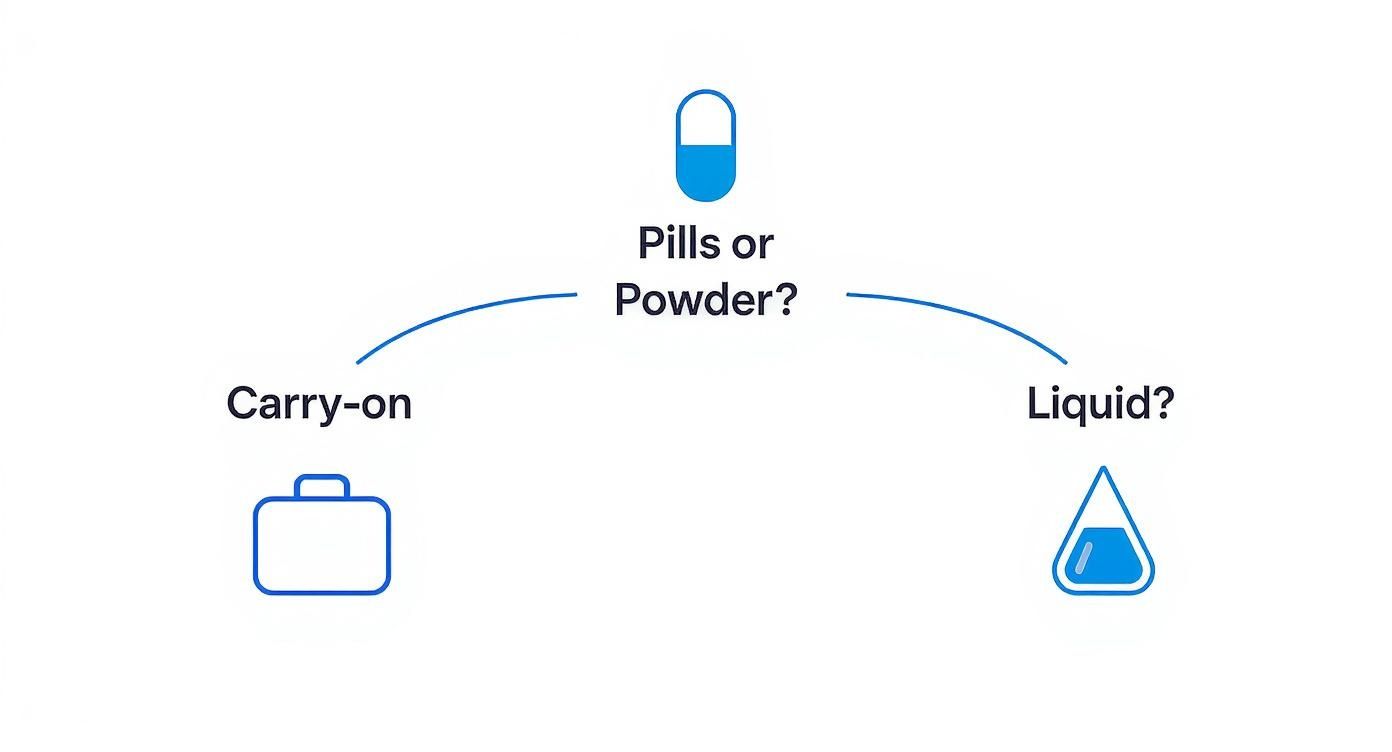
As you can see, the first question is always about the form—solid, powder, or liquid. That one detail dictates all the packing rules that follow.
Liquid and Gel Supplements: The 3-1-1 Rule
Now for the category with the strictest rules: liquids. This includes liquid vitamins, herbal tinctures, omega-3 oils, and even soft gels. If you want to pack these in your carry-on, you have to follow the TSA's famous 3-1-1 liquids rule.
If you're not familiar with it, here’s a quick breakdown:
- 3: All your liquids must be in containers that are 3.4 ounces (100 milliliters) or smaller.
- 1: All these small containers have to fit into a single, clear, quart-sized zip-top bag.
- 1: You only get one of these bags per passenger.
This rule is non-negotiable for most gels, creams, and liquids, so those fish oil soft gels and vitamin C serums definitely count. If your original bottles are too big, you'll need to transfer them into travel-sized containers.
There is one major exception: medically necessary items. If a doctor has prescribed a supplement for you, it is exempt from the 3.4-ounce limit. The crucial step is to declare these items to a TSA officer when you get to the checkpoint. Don't just send them through the scanner. Having a doctor's note or a copy of your prescription on hand is a smart move to explain why you need it and make the screening process go as smoothly as possible.
How to Pack Supplements for a Smooth Airport Experience
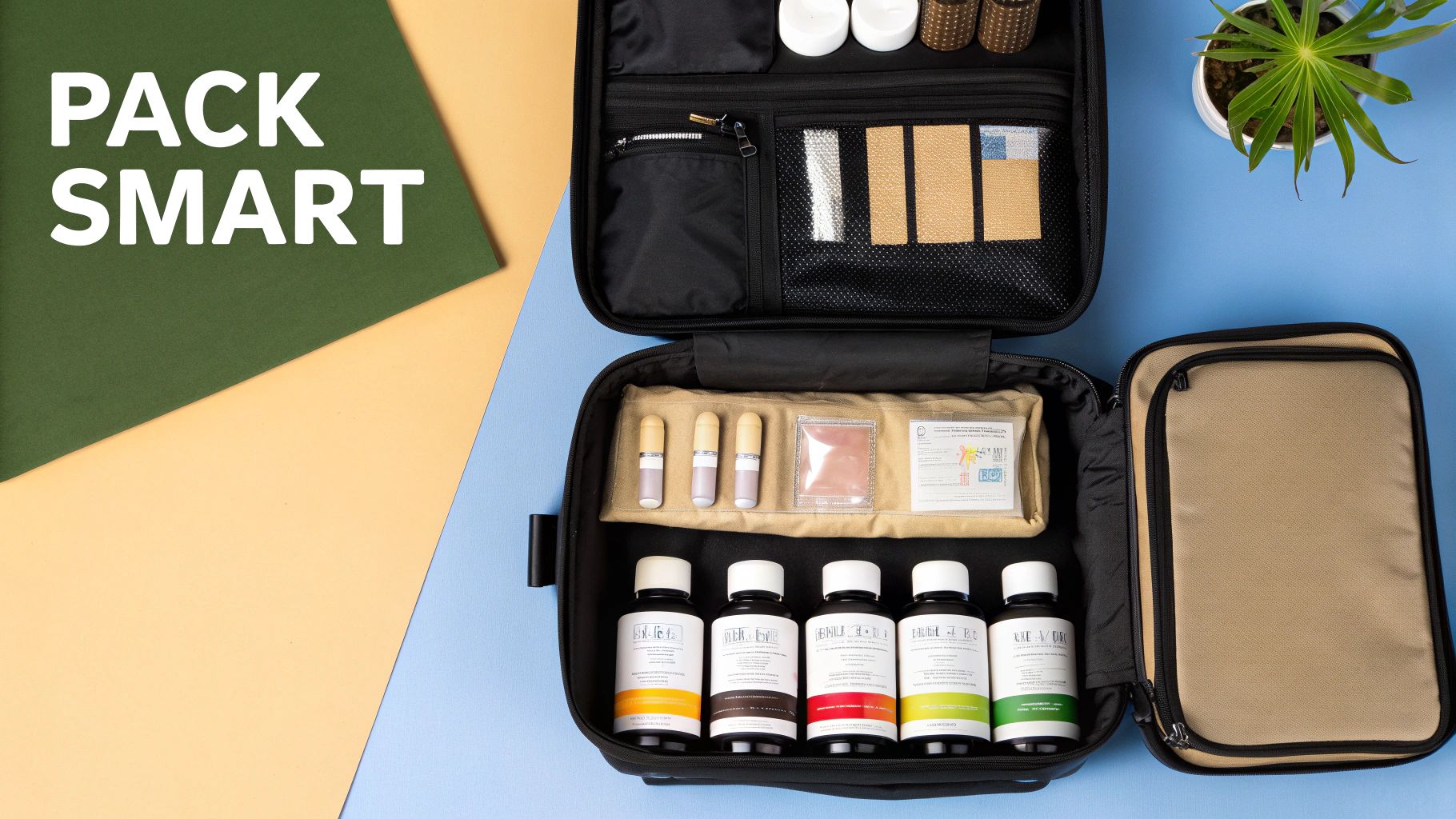
Knowing the rules is one thing, but packing smart is what really gets you through security without a hitch. The way you organize your supplements can make the difference between breezing through the checkpoint and getting pulled aside for a bag search. The goal here is clarity and accessibility.
Think about your carry-on like a well-organized toolkit. You want to grab what you need without dumping everything out. I always stash my supplements in an outside pocket or right on top, making them easy to pull out if needed. This is especially true for any powders over 12 ounces, which security will want to screen separately.
A little planning shows TSA agents you know the drill and helps them move you along faster. It's a simple step that can save you a lot of time and frustration.
Original Bottles Versus Pill Organizers
This is probably the biggest question I get: Should I bring the bulky original bottles, or can I just use a compact pill organizer? While the TSA doesn't have a strict rule forcing you to use original containers for over-the-counter stuff, there are pros and cons to each method.
Pill organizers are fantastic for saving space. They're lightweight, keep you on schedule with your daily doses, and are perfect for a short trip. The catch? The pills are anonymous. Without the original label, there’s no immediate way for an agent to know what they are.
Key Takeaway: For domestic flights, the TSA usually isn't concerned with unlabeled pills in an organizer. However, original bottles are highly recommended, especially for international travel, where customs officials are much stricter. Original packaging answers questions before they're even asked.
Keeping supplements in their original bottles is the most straightforward approach. It provides instant, official identification for any security or customs agent, leaving no room for doubt. The obvious trade-off is the space they take up in your luggage.
Here's a quick breakdown to help you decide what's right for your trip:
| Packing Method | Pros | Cons |
|---|---|---|
| Original Bottles | Clearly labeled and identifiable; minimizes security questions. | Bulky, heavy, and takes up a lot of luggage space. |
| Pill Organizers | Incredibly space-saving and lightweight; great for daily organization. | Pills are unidentified; could lead to questions or delays. |
Sometimes, a hybrid approach is the best solution. For anything essential or medically important, I stick with the original bottle. For basic vitamins like Vitamin C or Magnesium on a domestic trip, a clearly labeled pill organizer usually works just fine.
Practical Packing Tips for Every Supplement Type
Beyond the bottle-versus-organizer debate, a few other tricks will protect your supplements from the rigors of travel. Different forms—powders, capsules, liquids—need to be handled differently to arrive in one piece.
For instance, soft gels are notorious for getting crushed. I always pack them in a hard-shell case or tuck the bottle inside a shoe for some extra armor.
Here are a few more tips from my own travel playbook:
- Seal Your Powders: After tightening the lid on your protein or collagen powder, put the entire container inside a large zip-top bag. This "double-bagging" method has saved me more than once from a fine layer of powder coating everything in my suitcase.
- Count Your Servings: Figure out exactly what you need for your trip, then add two or three extra days' worth. This gives you a buffer for unexpected travel delays without weighing you down with a full bottle you don't need.
- Keep Gut Health in Mind: Travel can throw your digestion off, so if you take probiotics, keep them handy. To get the most out of them on your trip, it helps to understand the best time to take a probiotic.
A bit of organization and foresight is all it takes to make flying with your supplements completely stress-free.
Taking Your Supplements on International Flights
Flying domestically with your supplements is one thing, but crossing international borders is a whole different ball game. What you buy over the counter at home could easily be a restricted or even illegal substance somewhere else. Every country plays by its own set of rules, and pleading ignorance won't get you very far with a customs agent.
We're not just talking about obscure herbal concoctions, either. Everyday stuff like melatonin, DHEA, or even certain high-potency vitamins can land you in hot water. For instance, some countries treat melatonin as a prescription-only drug, while others sell it on grocery store shelves. This is exactly why doing your homework beforehand isn't just a good idea—it's non-negotiable.
Do Your Homework: Research Your Destination's Laws
Before a single pill goes into your bag, your first move is to dig into the supplement regulations of the country you're visiting. This is, without a doubt, the most important step to ensure your supplements make it through customs with you.
Here’s a simple process to get the right information:
- Start with the Embassy or Consulate Website: This is your most trustworthy source. Look for sections labeled "Customs," "Bringing Goods into [Country]," or "Prohibited and Restricted Items."
- Check the Country's Customs Agency Page: Most nations have a dedicated customs or border protection agency with official guides for travelers. This is often where you'll find the nitty-gritty details and specific lists.
- Search Smart: Use direct and specific phrases online. "Bringing vitamins into Japan" or "supplement restrictions UAE" will usually pull up more helpful traveler forums and official guidance than a generic search.
Taking the time to do this means you’re working with current, accurate information straight from the source, rather than relying on some outdated blog post or a friend-of-a-friend's story from five years ago.
Understanding What's Commonly Restricted
The global landscape for supplements can be incredibly confusing. An ingredient praised for its benefits in one country might be tightly controlled in another due to different safety standards or classifications. This is why you need to check every single ingredient on your labels.
The global supplement industry is massive and constantly changing. With over 100,000 products on the market in the U.S. alone, it's up to travelers to figure out what's allowed where they're going. This is a daily reality for the 2.7 million people who fly, many of whom need to understand these complex rules. You can dive deeper by exploring these regulatory insights for flying with dietary supplements.
Let’s look at a few real-world examples to see how much this varies:
- Japan: They are very strict about stimulants. Anything containing pseudoephedrine, a common ingredient in cold and allergy meds, is a huge red flag.
- United Arab Emirates (UAE): Here, melatonin is considered a prescription item. You can’t just bring it in your carry-on without a doctor’s official sign-off.
- Australia: Their Therapeutic Goods Administration (TGA) keeps a close watch on substances like DHEA and kava, which you can't bring in without special permission.
These examples make it crystal clear: never assume a supplement is fine just because you bought it legally back home. Always, always verify.
Why a Doctor's Note is Your Golden Ticket
If you're traveling with any supplement that's medically necessary or was prescribed by a doctor, that documentation is your best friend. A simple letter from your physician can be the key to breezing through customs, especially if you're carrying something on a country's restricted list.
Make sure the doctor's note is professional and contains all the key details:
- It should be on official letterhead.
- It needs to clearly state the name of the supplement or medication.
- It must explain why it is medically necessary for your health.
- It should also detail your dosage and the total amount you’re carrying for your trip.
Getting the letter translated into the local language is a great extra step, though English is usually fine at major international airports. When you pair this letter with your supplements kept in their original, clearly labeled bottles, you give customs officials a transparent, verifiable record. It’s the best way to avoid misunderstandings and unnecessary delays.
Special Considerations for Athletes and Medical Needs
The standard rules work for most of us, but for athletes or anyone with specific medical needs, the game changes. Supplements aren't just a "nice-to-have" for general health—they're a critical part of a performance plan, recovery protocol, or treatment for a health condition.
This means you’ve got to be a little more strategic. Your goal is to get through security and customs without a hitch, and that means thinking one step ahead of the agents. You need to provide clear, undeniable proof that everything you're carrying is legit, safe, and for your personal use.
Flying as an Athlete
If you’re an athlete, you know that traveling without your protein powders, creatine, or aminos just isn't an option. But let’s be honest: carrying big tubs of white powder is practically an invitation for a closer look from security.
Your top priorities are making sure your products are instantly identifiable and, if you're competing internationally, compliant with anti-doping regulations. The last thing you need is a perfectly legal supplement getting flagged as a banned substance. If you're weighing options, you can see our detailed comparison of whey vs. egg protein to figure out what works best for your travel and training.
To keep your journey smooth, lock down these best practices:
- Original Containers are a Must: This is non-negotiable. Never, ever transfer powders into unmarked baggies. The original, sealed container with its professional label is your best friend when questions arise.
- Check the Banned Substance Lists: Competing? Double-check that all your supplements are certified free of anything banned by groups like the World Anti-Doping Agency (WADA).
- Pack for Screening: Got a powder container over 12 oz (350 mL)? Be ready to pull it out of your carry-on for separate screening, just like you would with a laptop.
Medically Necessary and Prescription Supplements
When a supplement is prescribed by a doctor to manage a health issue, the rules bend in your favor. The TSA makes exceptions for medically necessary items, which includes letting liquids over the 3.4-ounce limit through. But—and this is a big but—you need the paperwork to back it up.
The key here is being proactive. Announce these items to the TSA officer right at the start of the screening process. Don't just slide them into the X-ray bin and cross your fingers. Being upfront and organized shows you’re a prepared traveler, not someone trying to sneak something by.
Think of your prescription as your VIP pass through security. A doctor's letter and a pharmacy-labeled bottle provide official proof that cuts through any doubt and helps security agents make a quick, easy decision.
This isn't just for domestic flights. When traveling internationally, a supplement that's over-the-counter at home might be a regulated medical product in another country. A doctor’s note explaining why you need it can be the one thing that prevents customs from confiscating an essential part of your health routine.
Whether you're an athlete chasing a personal best or a traveler managing your well-being, clarity is everything. Original labels, a doctor's note, and a prescription create a straightforward story that security and customs officials can easily understand and approve.
What to Do If Your Supplements Get a Second Look
Even when you've done everything right, a security or customs agent might still want to take a closer look at your supplements. The absolute best thing you can do is stay cool, calm, and collected. They’re just doing their job, and a little cooperation and clear communication will get you through the process smoothly.
Think of it this way: your neatly packed bag and original labels have already done most of the talking. You’re just there to fill in any blanks. If an agent pulls you aside, be ready to simply explain what you’re carrying. This is where having that doctor’s note or prescription can be a real game-changer.
If you find yourself in this situation, just follow these three simple steps:
- Be Patient and Cooperative: A friendly, helpful attitude makes all the difference.
- Explain What You Have: Keep it simple. "These are just my daily vitamins, and that's protein powder for the gym."
- Show Your Paperwork: If you have it, hand over your doctor's note or prescription. This official proof usually clears up any questions right away.
Why Do Agents Ask Questions Anyway?
It helps to see things from their perspective. Airport security agents screen countless bags every day, and they’re trained to spot anything out of the ordinary—whether that’s an unmarked container or just a surprisingly large amount of something. They aren't trying to give you a hard time; they're just following protocol.
Having your supplements in their original, clearly labeled bottles is your best line of defense. It instantly shows you're an organized traveler who knows the rules for bringing supplements on a plane.
Let's be honest, the supplement world is huge and not always tightly regulated. The FDA only inspects about 5% of known supplement facilities each year, so agents often have to rely on proper packaging and your explanation to verify what something is. You can learn about the scope of FDA supplement investigations to get a better sense of this.
Ultimately, by being organized and upfront, you're making their job easier and helping ensure you get to your gate without any unnecessary delays.
Frequently Asked Questions About Flying with Supplements
Even after you've read all the official rules, those last-minute packing questions always seem to surface. What if I miss something? Let’s clear up some of the most common uncertainties travelers face when deciding how to fly with their supplements. Think of this as your final pre-flight check for total peace of mind.
Do I Have to Declare My Supplements at Security?
For most supplements, the answer is a simple no. If you're carrying standard pills, capsules, or powders, you don't need to announce them to a TSA agent. Just leave them in your carry-on bag and send it through the X-ray scanner as you normally would.
The big exceptions are medically necessary liquids over the 3.4oz/100ml limit and any powders in containers larger than 12oz/350ml. It’s a good idea to pull these items out of your bag and mention them to a TSA officer. Giving them a heads-up makes their job easier and gets you through screening faster.
Can I Bring Gummy Vitamins on a Plane?
Yes, absolutely! This one trips people up all the time, but the TSA doesn't see gummy vitamins as a liquid or a gel. They're treated just like solid food.
That’s fantastic news because it means gummy vitamins are not subject to the 3-1-1 liquids rule at all. You can pack as many as you want in either your carry-on or your checked luggage without a second thought. Just a practical tip: they can get a little melty or sticky in hot weather.
Should I Pack Supplements in My Carry-On or Checked Bag?
Here's my golden rule: always pack essential or prescribed supplements in your carry-on bag. I can't stress this enough. Checked bags get delayed, and sometimes they get lost. You never want to be stuck in a new place without supplements you truly need.
Keeping essential supplements with you in the cabin is your personal insurance policy. It guarantees you have what you need, no matter what happens to your checked luggage.
For everything else—like that giant tub of protein powder you're not using until day three—your checked bag is the perfect spot. This frees up precious space and weight in your carry-on and keeps your security screening experience as quick and simple as possible.
Will Customs Agents Open My Supplement Bottles?
It's certainly possible, though it doesn't happen every time. Customs officers have the final say on inspecting anything you bring into their country. They're more likely to take a closer look if your pills are in an unmarked bottle or if you're carrying a quantity that seems too large for personal use.
The best way to avoid a lengthy inspection is to keep your supplements in their original, factory-sealed containers. Those professional labels answer most questions before an agent even has to ask. If they do ask, just be ready to calmly explain what each item is for. Staying organized shows you're a savvy traveler, which usually makes for a much smoother process.
At Premium Supplements, we provide high-quality, clearly labeled products perfect for your travel needs, ensuring you can maintain your wellness routine wherever you go. Find your travel-ready essentials at https://premiumsupplements.xyz.
Article created using Outrank